
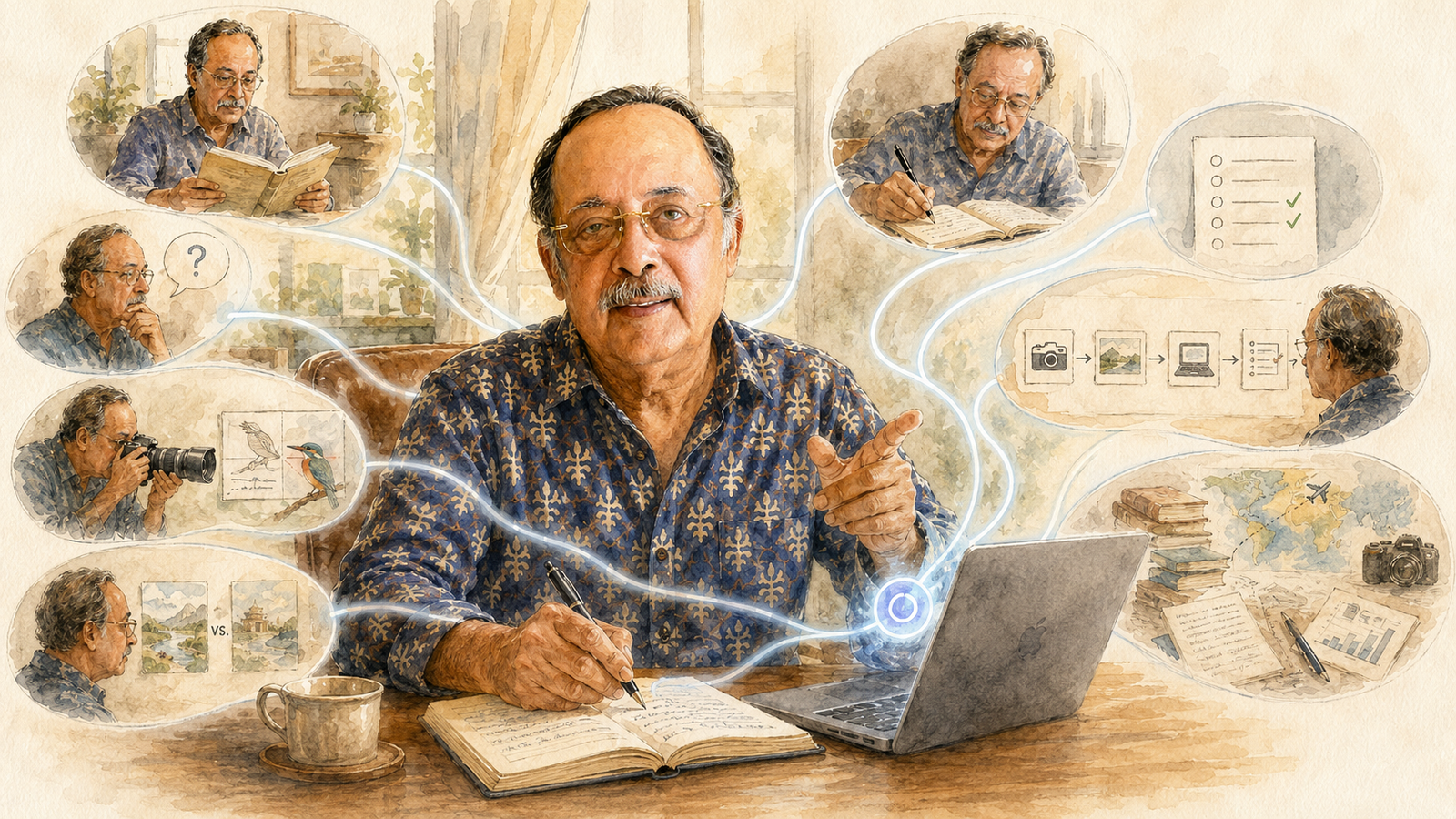
Learning has always been important to me. Over the years, the subjects may have changed—photography, technology, digital tools, business, travel, writing—but the curiosity has remained the same.
What has changed dramatically is how I learn.
In the past, learning something new usually meant finding the right book, attending a course, searching through websites, watching several videos, or asking someone with more experience. All of these methods are still valuable. But artificial intelligence has added something different: a learning companion that is available almost instantly and can adapt itself to the way I want to understand a subject.
AI has not replaced books, teachers, courses, or experience. Instead, it has made the process of learning faster, more interactive, and much more personal.
Here are some of the biggest ways AI has changed the way I learn.
1. I Can Start With a Question, Not a Course
One of the biggest differences is that I no longer need to know exactly where to begin.
Earlier, if I wanted to learn about a new subject, I first had to identify the right book, website, teacher, or course.
Now I can simply begin with a question.
For example:
“What do I need to understand before learning bird photography?”
“Explain autofocus tracking in simple terms.”
“What are the basics of creating an online course?”
“Teach me the essentials of AI for everyday productivity.”
That first answer is rarely the end. It is the beginning of a conversation.
AI helps me enter a subject quickly, without having to spend hours finding the perfect starting point.
2. I Can Ask Unlimited Follow-Up Questions
This is perhaps the greatest advantage.
When reading a book or watching a video, I may come across something I do not fully understand. The author or presenter cannot stop and explain it specifically for me.
AI can.
I can ask:
“Explain that more simply.”
“Give me an example.”
“Why does that happen?”
“How would this apply in real life?”
“What is the difference between these two ideas?”
And if the explanation is still unclear, I can ask again in a different way.
This turns learning into a dialogue rather than a one-way flow of information.
3. I Can Learn at My Own Level
Everyone learns differently.
Sometimes I want a very simple introduction. At other times, I already understand the basics and want a deeper explanation.
AI allows me to control the level.
I can ask:
“Explain this for a complete beginner.”
“Now take it to an intermediate level.”
“Give me the technical version.”
“Explain this without jargon.”
That flexibility is extremely useful because traditional learning material is usually written for a broad audience.
AI can adjust the explanation to me.
4. I Can Turn Complex Subjects Into Simple Steps
Many subjects feel difficult not because they are impossible, but because they are presented all at once.
AI is good at breaking things down.
If I want to learn something complicated, I often ask:
“Break this into five stages.”
“What should I learn first?”
“What can I ignore for now?”
“Create a seven-day learning plan.”
This is especially useful with technology.
Instead of trying to understand an entire software program, camera system, or AI tool in one sitting, I can focus on the small part I need today.
Learning becomes less intimidating when the next step is clear.
5. I Can Learn Through Examples
Theory is useful, but examples often make ideas understandable.
Suppose I am trying to understand a photography concept such as depth of field.
I can ask AI:
“Explain depth of field using three real photography situations.”
Or if I am learning about business:
“Give me an example of how a small creator could turn expertise into a digital product.”
Examples connect abstract ideas to reality.
And because AI can generate several different examples quickly, I can keep exploring until one makes sense to me.
6. I Can Compare Ideas More Easily
Learning is not always about finding one correct answer.
Often I need to understand differences.
For example:
Mirrorless camera versus DSLR.
Full frame versus Micro Four Thirds.
Online course versus ebook.
Blog versus newsletter.
AI can create a side-by-side comparison and explain the strengths and weaknesses of each option.
More importantly, I can add my own priorities.
“Compare these from the point of view of someone who values portability.”
“Compare these for a beginner.”
“Compare these for a small business.”
That makes the learning more relevant.
7. I Can Turn Learning Into a Project
I have found that I learn best when I create something.
Instead of only reading about a subject, I may decide to write an article, create a video, build a course, prepare an ebook, or test a photography technique.
AI helps connect learning with doing.
For example:
“Create a project that will teach me the basics of travel photography.”
“Help me build a beginner course on this subject.”
“Turn these concepts into a practical checklist.”
“Give me an exercise to test what I have learned.”
This changes learning from passive consumption into active application.
And that is where real understanding often begins.
8. I Can Use AI as a Practice Partner
AI can also test me.
After studying something, I can ask:
“Ask me ten questions on this topic.”
“Give me a short quiz.”
“Give me a photography problem and ask me what settings I would choose.”
“Challenge my understanding.”
This is valuable because we often think we understand something until we are asked to explain or apply it.
Testing exposes the gaps.
9. I Can Connect Different Subjects
One of the more interesting things about AI is how easily it helps connect ideas from different areas.
Photography can connect with storytelling.
Travel can connect with history.
AI can connect with productivity.
Learning can connect with business.
I might ask:
“How can lessons from wildlife photography apply to patience and decision-making?”
Or:
“How can AI help me turn photography knowledge into a course?”
These connections often produce new ideas.
Learning becomes less about separate subjects and more about understanding how things relate to one another.
10. I Can Learn When I Need the Knowledge
Traditional learning often happens in advance.
You take a course because you might need the knowledge later.
AI makes something else possible: learning at the moment of need.
If I am working on a video and encounter a problem, I can learn the solution immediately.
If I am preparing for a photography trip, I can research the exact conditions I expect.
If I am writing an article, I can explore the parts of the topic I do not understand.
This “just-in-time learning” is extremely efficient.
The knowledge is immediately connected to something I am doing.
But AI Has Not Replaced the Fundamentals
There is an important caution.
AI can make learning easier, but easier does not necessarily mean better.
It can produce incorrect information. It can oversimplify. It can sound confident even when it is wrong.
For important facts, I still believe in checking reliable sources.
Books still matter.
Good courses still matter.
Teachers still matter.
Practice certainly matters.
And experience cannot be downloaded.
The best way to use AI is not to let it do the thinking for us, but to use it to help us think better.
Learning Has Become More Personal
Perhaps this is the biggest change for me.
Learning is no longer simply about finding information.
Information is everywhere.
The real challenge is understanding what matters, asking better questions, connecting ideas, applying what we learn, and continuing to remain curious.
AI makes that process more personal.
It allows me to explore at my own pace, ask questions without hesitation, move from simple explanations to deeper understanding, and turn curiosity into practical projects.
And that may be one of the most exciting things about AI.
It does not just give us answers.
Used well, it can encourage us to keep asking questions.
0 Comments